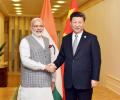
China also advocated an "out of the box" thinking to arrive at a consensus over the issue of entry of non-NPT countries into the NSG.
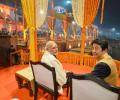
'Modi and Abe are working seriously for India-Japan bonhomie to grow stronger.' 'It is a win-win situation for both countries and the future look promising,' says Rajaram Panda, the Indian Council for Cultural Relations India Chair Visiting Professor at Reitaku University, Japan.

There is nothing to be worried about as bilateral ties are robust with solid foundations. Both are on the same page on the economic and defence/security ties bilaterally and globally and that shall continue irrespective of change in political dispensation in either country, points out Dr Rajaram Panda.

Mukherjee said Prime Minister Narendra Nodi and Chinese President Xi Jinping Would be meeting soon on the margins of G-20 summit scheduled to be held in China later this year.

'The Modi visit will prove to be the watershed where India and the United States commenced technology trade and transfer.'

Biden, the first US Vice President to visit India in three decades, welcomed relaxation of foreign direct investment norms in certain sectors but said a lot more needed to be done to remove trade barriers.

'Ensuring through diplomatic means and in conjunction with strategic partners that India will not be required to fight a simultaneous two-front war with China and Pakistan.' Brigadier Gurmeet Kanwal (retd) lists what India must have in its national security strategy.

Official sources said the two leaders will meet for around four to six hours for the 'agendaless' talks

In a series of tweets -- in Russian and then in English -- on the eve of his visit to Russia, Modi said he looked forward to his meeting with Putin.
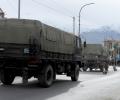
China is in no hurry to disengage at the border and the region and international community is moving on. The spectre of a long haul in Ladakh haunts India, points out Ambassador M K Bhadrakumar.

Speaking at a joint press event with Macron, Modi, who is in Paris on a two-day official visit, said a roadmap to strengthen India-France strategic ties over the next 25 years was being prepared with bold and ambitious goals on the anvil.
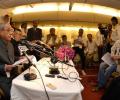
China has conveyed its willingness to enhance cooperation with India on combating the menace of terrorism, including in the United Nations, President Pranab Mukherjee said on Friday winding up a "fruitful and productive" four-day visit to that country.

Assistant Secretary of State for International Security and Non-Proliferation Thomas Countryman said.
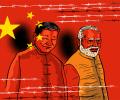
'The government's August 5 decision has impacted India-China relations, but it is not very significant or very different. Things like this have happened in the past.'

The lingering boundary issue will also feature in his talks with his Chinese counterpart Xi Jinping, Premier Li Keqiang and other leaders, says R Rajagopalan, who will travel to Beijing with the President.

India and China met and spoke a lot this year, but failed to produce any meaningful results.
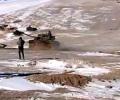
Who knows, the moment of truth in Ladakh may also augur for a giant leap toward boundary settlement with China in the fulness of time. The news that the special representatives of the two countries are planning to meet gives a positive signal, suggests Ambassador M K Bhadrakumar.

Stating that India's entry into Nuclear Suppliers Group will "shake strategic balance in South Asia and even cast a cloud over peace and stability in the entire Asia-Pacific region", an article in the state-run 'Global Times' however said China could support India's inclusion in the 48 member nuclear club if it "played by rules".

Leaders of the United States, India, Australia and Japan did discuss the 'challenge' posed by China during the first meeting of the Quad, and they made clear that none of them have any 'illusions' about Beijing, US National Security Advisor Jake Sullivan has said.

China and India on Wednesday held their upgraded strategic dialogue to shore up bilateral ties amid hectic parleys to resolve differences over Beijing's reluctance to support India's bid for Nuclear Suppliers Group membership as well as a United Nations ban on JeM chief Masood Azhar.

Jaishankar's talks with Yang and later in the Strategic Dialogue were expected to cover the key India-China differences like China blocking India's bid to join the NSG and UN ban on Azhar.

India and China have agreed to maintain peace and tranquillity in the border areas which was a "pre-requisite" for continued growth of bilateral relations as also to enhance cooperation in key areas, including counter-terrorism, maritime security and civil nuclear energy sector.
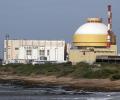
A lowdown on why NSG membership is important for India

Is North Korea really dismantling its nuclear programme? Rajaram Panda explains the many challenges to denuclearise the Korean Peninsula.
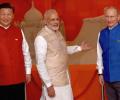
'With Pakistan's 'first use doctrine' threatening the use of nuclear weapons early in a war with India, the S-400 will shield vulnerable targets like Delhi and Mumbai, complicating Pakistan's targeting calculations.'

Prime Minister Narendra Modi and French President Emmanuel Macron held extensive discussions on a range of bilateral and pressing global issues, including the raging conflict in Ukraine, the situation in the Indo-Pacific and terrorism, as the two top leaders agreed on a blueprint to work together in making the India-France strategic partnership a force for global good.

Prime Minister Narendra Modi on Tuesday left for home after wrapping up his six-day tour that took him to China, Mongolia and South Korea.

Prime Minister Manmohan Singh left for China on Tuesday on the second leg of his two-nation tour after meeting Russian President Vladimir Putin in Moscow during which the two leaders pledged to "resolve all outstanding issues" related to the Kudankulam nuclear project.

The Indian troops guarding the nearly 3,500-km Line of Actual Control (LAC) maintained an assertive approach in sync with the broader national security doctrine and procured a variety of military platforms and weapons to enhance their combat capabilities.

China plans to divert about 200 billion cubic metres of water annually from the Brahmaputra at its highest point, namely the Great Bend, where it turns into India. China's Brahmaputra dam will severely impact India, warns former senior RA&W officer and China expert Jayadeva Ranade.

Rulers in New Delhi and their political aides in sensitive states like Tamil Nadu have to be doubly careful not to provoke a situation whose consequences may be much more than visible now to the naked eye, notes N Sathiya Moorthy.
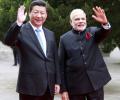
China's Vice Foreign Minister Li Baodong again harped on the need to build consensus over the admission of new members in the 48-member Nuclear Suppliers Group.

'China has gone too long as a rogue power, trashing international norms, agreements, and treaties as if they were not the paper they were written on.' 'The ill-advised attack on Ladakh may be the beginning of the end of that nonsense,' advocates Rajeev Srinivasan.

Speculation is rife that Xi is likely to make an attempt to initiate peace talks between Russia and Ukraine to end the ongoing conflict in Ukraine.

The move comes amid hectic diplomatic manoeuvring between the two countries over a host of issues like Nuclear Suppliers Group and designation of Masood Azhar as a terrorist by the United Nations.
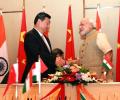
'China's actions at the NSG will certainly taint India-China bilateral relations and enhance suspicion of China's intentions. A fresh clear-eyed and objective evaluation of the India-China relationship is necessary, especially as India tries to correct adversely balanced bilateral economic ties and the two countries engage over the long-term,' says Jayadeva Ranade.
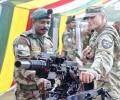
Acknowledging that it is clear to all that many terrorist groups operate in Pakistan, he said the US continues to work with the Pakistani government in this regard.
Pakistan turned to China after the US refused it a civilian nuclear agreement.
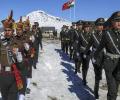
With regard to where relations between New Delhi and Beijing stand, the Union minister said that he does not have a definite answer to offer at "this moment".
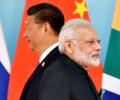
'The events of 2020 have actually put our relationship under exceptional stress.' What External Affairs Minister Dr Subrahmanyam Jaishankar told the All India Conference of China Studies on Thursday, January 28, 2021.
 © 2026 Rediff.com - Advertise with us - Disclaimer - Privacy Policy - Sitemap - Feedback - About us - Terms of use - Grievances